Battle at the Carmes-Deschaux
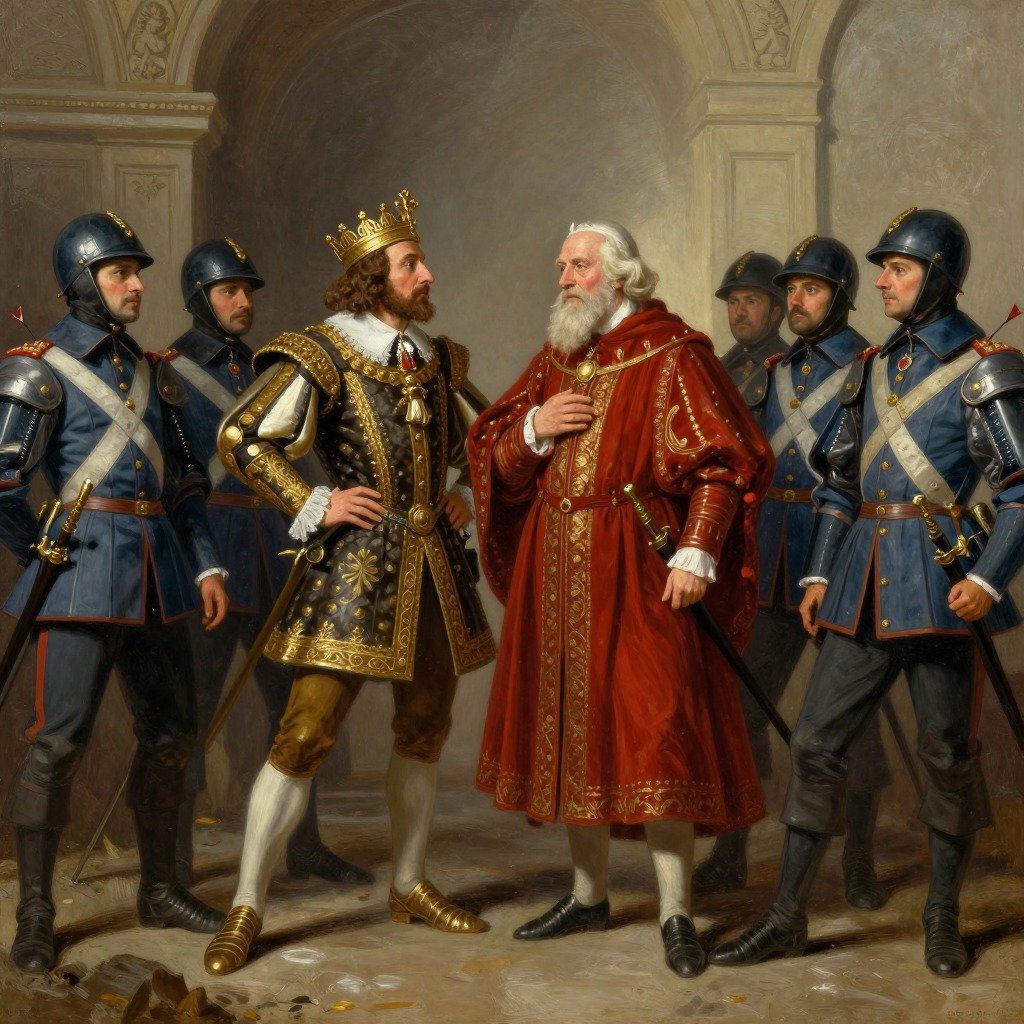
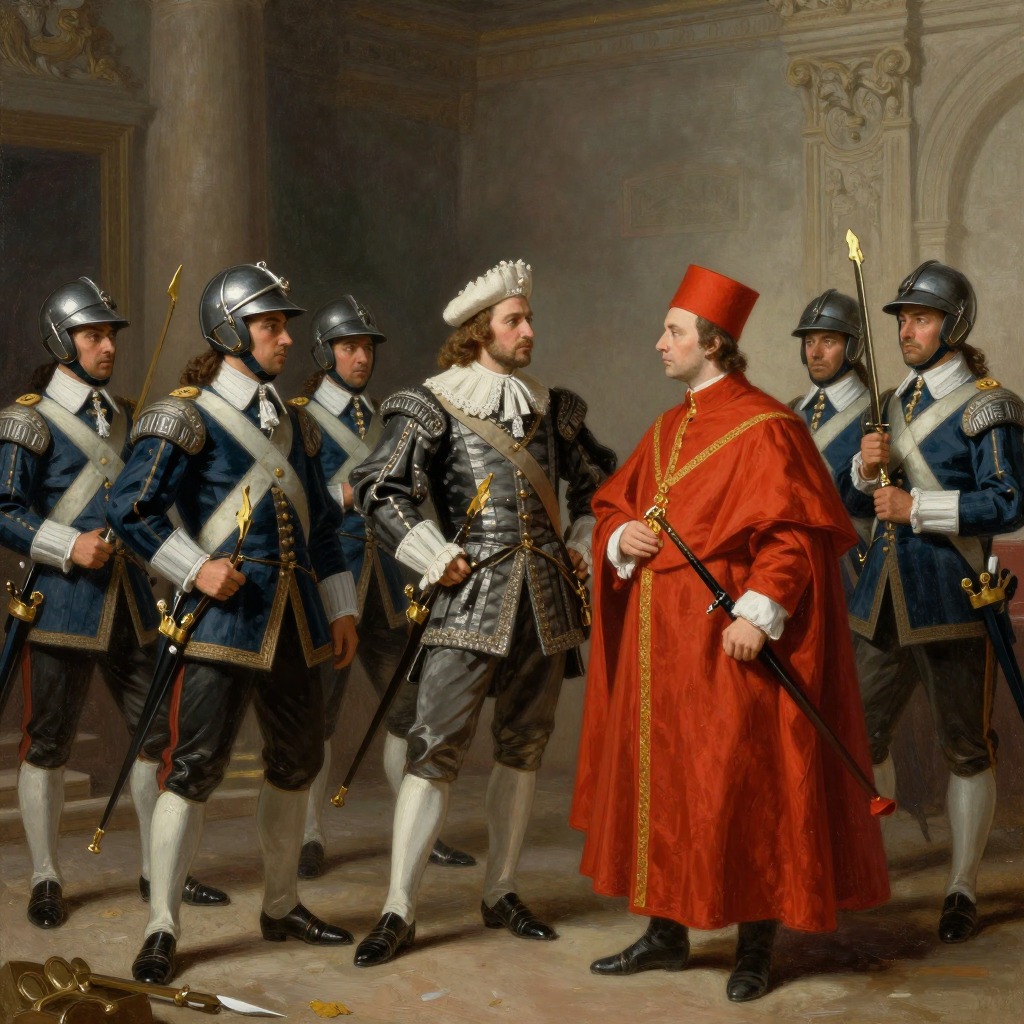
The Battle at the Carmes-Deschaux marks the first time d'Artagnan fights alongside Athos, Porthos, and Aramis, transforming a series of personal duels into a collective stand against the Cardinal's Guards. This skirmish, which erupts when a patrol of Guardsmen led by Jussac interrupts the four friends at the deserted convent, cements the alliance between the young Gascon and the three Inseparables and sets the stage for their ongoing conflict with Cardinal Richelieu.
Causes and Background
The battle is the culmination of a single, eventful morning. D'Artagnan, having just arrived in Paris, has managed to offend all three Musketeers in quick succession: he collides with Athos, aggravating his wound; becomes entangled in Porthos's cloak, exposing the sham of his gold-embroidered baldric; and clumsily returns a handkerchief belonging to Aramis, implicating him in a delicate affair with Madame de Bois-Tracy. Each Musketeer challenges him to a duel, and d'Artagnan, following his father's counsel to "endure nothing from anyone except Monsieur the Cardinal and the king," accepts all three. The duels are scheduled consecutively at the Carmes-Deschaux, a bare spot of ground behind the Luxembourg, a common venue for such affairs. D'Artagnan arrives first for his appointment with Athos, who, still suffering from a recent wound, waits with his hat in hand. When Porthos and Aramis arrive, they reveal themselves to be Athos's seconds, and the four men realize they are entangled in a web of three separate duels.
What Happens
As Athos and d'Artagnan are about to cross swords, a company of the Cardinal's Guards, commanded by Jussac and accompanied by Cahusac and Bicarat, turns the corner of the convent. Jussac, recognizing the Musketeers, orders them to sheathe their swords, citing the king's edicts against dueling. Athos, Porthos, and Aramis refuse, and a tense standoff ensues. D'Artagnan, though not yet a Musketeer, declares, "I have not the uniform, but I have the spirit," and chooses to fight alongside them. The nine combatants rush upon each other. Athos engages Cahusac, Porthos fights Bicarat, and Aramis faces two adversaries. D'Artagnan, his heart beating with emulation rather than fear, springs toward Jussac himself. Despite Jussac's reputation as a fine blade, d'Artagnan's agility and unorthodox style exhaust his patience. Jussac makes a mistake, and d'Artagnan, gliding "like a serpent beneath his blade," runs him through. The young Gascon then aids Athos, who is wounded anew, by disarming Cahusac, whom Athos subsequently kills. Aramis forces his remaining opponent to surrender, and the four friends surround Bicarat, who, though alone and wounded, refuses to yield until Jussac commands him. Bicarat then breaks his sword across his knee in surrender.
Consequences and Aftermath
The battle results in a decisive victory for the four friends. Jussac, Cahusac, and one of Aramis's adversaries are wounded; a fourth Guardsman is dead. The Musketeers, carrying away four swords out of five, walk arm in arm back to M. de Treville's hotel, their triumphal march swelling as they gather other Musketeers along the way. D'Artagnan, marching between Athos and Porthos, declares, "If I am not yet a Musketeer, at least I have entered upon my apprenticeship." The affair makes a great noise. M. de Treville scolds his Musketeers in public but congratulates them in private, and he hastens to the Louvre to report to the king. The king, after hearing Treville's account, is impressed by d'Artagnan's bravery and grants him an audience, which leads to his eventual promotion into the Musketeers. The battle also solidifies the enmity between the four friends and the cardinal, who is furious at the loss of his Guardsmen. The event establishes the "All for one, one for all" ethos that will define the quartet's subsequent adventures.